

A union’s first step to gain new members is getting employees to show support, usually by signing authorization cards, petitions, or agreeing online.
Whatever form it takes, these expressions of employee support are legally binding!
It’s important to understand the facts about union authorization cards and other solicitations so you can make an informed choice if you are asked to sign a physical or online authorization card – whether it’s by a union organizer or one of your fellow employees.
Union organizers may say signing an authorization card is just so that you can get more information but that’s not true. Your signature is very valuable to the union. You should never have to sign anything just to get more information.
Click the questions below to see the answers.
A union authorization card or petition – also called a “union card” – is a legal document that potentially can give a union the sole and exclusive right to speak and act on behalf of the employees in all matters regarding wages, benefits, and terms and conditions of employment at SSM Health.
No. But it is the first step toward unionization, and that is why we suggest you carefully think about what signing a card/petition means.
Union organizers and employees who support them can be extremely persistent and aggressive. We want you to have the facts about your legal rights. Federal law provides employees with:
The right to sign or not sign a union card
The right to campaign for or against the union
The right to not be bothered by union supporters while you are working or in patient care areas
The right to talk or not talk to a union representative if you are contacted at home or approached on your way to/from work
The right to tell union organizers you are not interested
The right to say “no”
The union can do several things with a signed authorization card/petition.
If the union gets 30% of employees in a bargaining unit (employee group) to sign cards, the union could go to the National Labor Relations Board (NLRB) and file a petition for an election in which employees vote to determine whether or not they want to be unionized.
If the union gets enough signatures on a petition or signed cards – typically, a majority of the employees the union wants to represent it – it can demand SSM Health recognize it as the bargaining agent for all the employees in certain unit or units. Under this scenario, you could become unionized without a secret ballot election.
The union can keep the card because it’s valid for at least one year from the day it’s signed. (Organizers also may ask employees not to date the card, which means the signed card remains valid longer.)
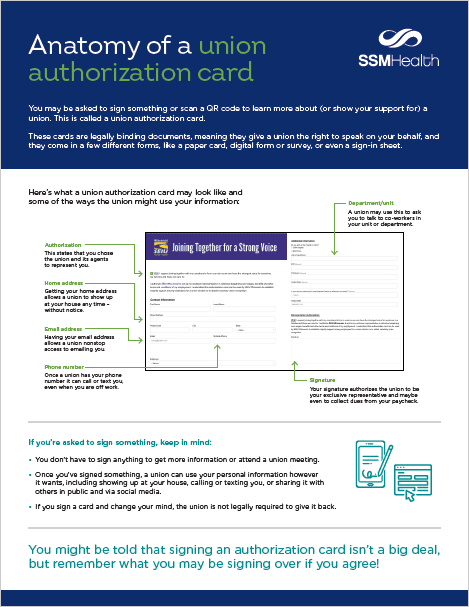
The union may use it to send you mail, to call you at home or to visit you at home.
Authorization documents can take many forms and generally look harmless.
Hard copy cards may resemble a magazine subscription renewal card.
Petitions may look like a normal piece of paper often with very small writing outlining the legal obligations that come with signing.
Some authorization documents are simply online forms that ask you to click on “I agree.”
Regardless of their appearance, however, a signed authorization card is a legal power of attorney that authorizes a union to act as the collective bargaining agent for you and other employees in negotiations with the employer. The documents also provide the union with personal information, including a home address and telephone number so the union representatives can contact you or visit you at home. The card may ask what department you work in and the type of work you perform. The NLRB requires only a signature and date on authorization cards; it is the union that wants the additional information about you that is requested on a card.
Signatures on union authorization documents can be gathered in a number of ways including:
Going to your home and asking to come in and speak with you
Online and through texts and emails
Waiting for you as you leave work
Approaching you and other employees in SSM Health facilities while at work, in the break area or in the parking garage
Through meetings purported to offer professional education credits
Through sign-in sheets at informational meetings
Through co-workers who support the union
Through flyers sent to your home with cards attached
Signing a union authorization card, petition or online form does not guarantee anything. If a union were to be voted in, the only thing it can do is negotiate on behalf of those it represents. In contract negotiations, you could end up with more, the same or less than you currently have. No one can predict the outcome of union contract negotiations.
An employee who signs a card and then later changes their mind has every right to ask for the card back, and to rescind their authorization of union representation by sending a letter via certified mail to the union’s local office. It is also a good idea to send a copy to the National Labor Relations Board regional office as well, so that they know that the employee has revoked the authorization and requested that the card be returned. An employee also can attempt to revoke the card by asking the person the card was given to, to return it.